
As organizations react to AI, the clickless funnel, and changing buyer behaviour, many are optimizing individual functions while the system itself becomes increasingly fragmented. That may be one of the biggest growth challenges hiding in plain sight.
Activity Is Increasing. Alignment Isn’t.
The clickless funnel is changing how people discover information. AI is changing how people research. Traditional search behaviours are shifting. Attribution is getting messier. The old playbooks aren’t working as they once did (it’s a tough time to be a gated ebook).
As a result, companies are moving.
Some are investing more heavily in brand. Bigger campaigns. More events. More earned media. More attention-grabbing creative. More focus on creating visibility in a world where getting attention feels increasingly difficult.
Others are doubling down on GTM efficiency. Better data. More intent signals. More automation. More AI-powered outreach. More pressure to connect activity directly to pipeline.
Neither response is inherently wrong.
What I’ve found interesting is that many organizations seem to be optimizing individual functions while the system itself becomes increasingly fragmented.
And that may be the bigger problem.
Over the past few years, we’ve worked with organizations of different sizes, across different industries, with different levels of marketing maturity. Yet a surprisingly similar pattern shows up again and again.
Brand teams are trying to improve awareness.
Demand generation teams are trying to improve conversion.
Sales teams are trying to improve close rates.
Operations teams are trying to improve data quality.
Everyone is working hard. Everyone is trying to make things better.
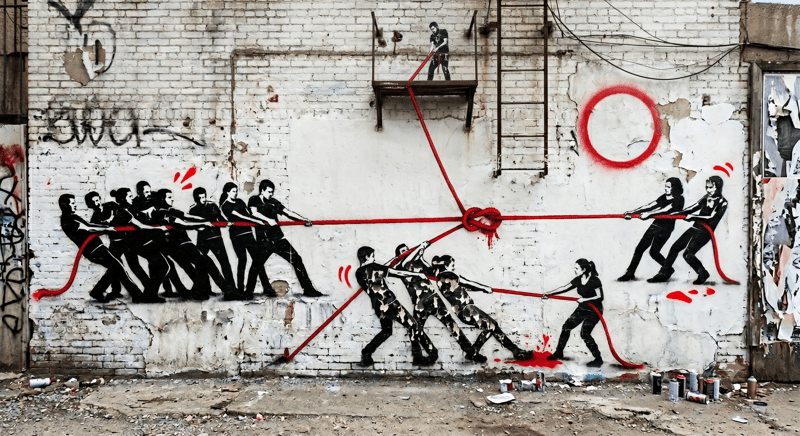
But not always together.
The result is often a growing collection of initiatives that make sense independently, but don’t always reinforce one another.
Activity increases.
Alignment doesn’t.
The Theatre of Progress
One of the challenges with modern marketing is that it’s become very easy to demonstrate activity.
It’s much harder to demonstrate alignment.
A brand team can point to reach, engagement, earned media, event attendance, and awareness metrics. A GTM team can point to intent signals, account engagement, meetings booked, opportunity creation, and pipeline influence.
Both can produce dashboards. Both can produce reports. Both can show movement.
The harder question is whether those activities are contributing to a shared outcome.
We’ve seen organizations invest heavily in account-based marketing only to discover that their definition of ABM amounts to little more than account-level retargeting.
We’ve seen intent platforms generate lists of accounts that are supposedly “in market,” only for sales teams to quietly ignore them because the signals don’t feel actionable enough to justify changing behaviour.
We’ve seen brand campaigns generate attention and positive sentiment while GTM leaders struggle to understand how any of it connects to revenue generation.
Anything can be what people are willing to believe it is.
Any chart can look convincing if nobody asks the next question.
That isn’t a criticism of marketing teams. It’s a symptom of fragmented systems trying to measure success independently from one another.
The Problem Usually Isn’t Marketing
It’s organizational design.
Most companies don’t wake up one day and decide to create silos.
They emerge gradually.
New teams are added. New agencies are hired. New technologies are introduced. New leaders arrive with new mandates.
Eventually, different groups become responsible for different parts of the customer experience.
The brand team owns one piece, the demand generation team owns another, sales owns another, operations another, customer success another.
Each group develops expertise. Each group develops its own processes. Each group develops its own metrics.
Over time, the connective tissue becomes harder to see.
This creates an interesting contradiction.
Many organizations genuinely want collaboration. They talk about it often. They invest in it. They put it in presentations, town halls, and leadership communications.
Yet a few management layers down, people are often rewarded based on the success of their own function rather than the success of the system.
We’ve seen organizations publicly champion experimentation while quietly rewarding risk avoidance.
We’ve seen organizations publicly celebrate challenger thinking while making it difficult internally to challenge established assumptions.
We’ve seen leaders advocate for unity while different teams compete for budget, influence, ownership, and credit.
None of this happens because people are bad at their jobs.
It happens because systems tend to produce the behaviours they reward.
Brand and GTM Were Never Meant to Be Separate Conversations
One of the stranger developments in modern marketing is how often brand and go-to-market are discussed as though they are separate disciplines.
I understand how we got here.
The work is often assigned to different teams, different agencies, and different budgets. Different people are accountable for different outcomes. Over time, it becomes natural to think of them as separate conversations.
The market doesn’t experience them that way.
Prospects don’t neatly separate the event they attended, the campaign they remember, the article they read, the webinar they watched, and the sales conversation they had three months later. Those experiences accumulate. Together, they shape confidence, familiarity, trust, and buying behaviour.
That’s why it has always felt odd to me when organizations treat brand and GTM as though one matters more than the other.
Organizations that focus exclusively on brand often struggle to explain how awareness eventually translates into business outcomes.
Organizations that focus exclusively on GTM often become exceptionally efficient at processing demand without investing enough energy into creating it.
Both approaches eventually hit a wall.
The organizations that seem best positioned for what’s coming next are not choosing between brand and GTM. They’re building operating models that allow both disciplines to inform one another.
The brand team understands the commercial objectives.
The GTM team understands the role that brand plays in shaping future demand.
The data strategy supports both.
The measurement framework supports both.
The customer experience benefits from both.
That sounds obvious when written down.
In practice, it’s surprisingly rare.
The Next Wave Will Punish Fragmentation
The rise of AI, conversational search, agentic systems, and increasingly connected buying journeys is exposing a reality that has existed for years.
Disconnected systems produce disconnected outcomes.
Organizations are spending enormous amounts of time trying to connect data, connect teams, connect processes, connect reporting, and connect customer experiences that were never designed to work together in the first place.
Meanwhile, more agile competitors are emerging.
They don’t have decades of organizational inertia to navigate. They aren’t trying to reconcile eight different definitions of success. They aren’t spending months debating ownership while markets move around them.
They can move faster.
They can experiment faster.
They can connect ideas faster.
And increasingly, they can build operating models where brand, GTM, data, technology, and customer experience are designed together rather than stitched together afterward.
That doesn’t guarantee success.
But it does create an advantage.
The Opportunity
The opportunity is more fundamental than simply swapping or adding agencies, restructuring departments, or chasing the latest trend.
It’s about finding people who can see beyond their own area of expertise. People who care about how the pieces connect. People who understand that brand, GTM, customer experience, data, and technology are all part of the same growth system.
The organizations that figure this out won’t simply produce better campaigns, cleaner dashboards, or more efficient workflows.
They’ll build teams that can move together.
That matters because the risks of fragmentation don’t show up immediately. Large organizations can continue to generate momentum for years on the strength of existing customer relationships, market position, and historical success. The warning signs often emerge slowly.
Projects take longer. Alignment becomes harder. Teams become more protective. Marketing activity increases while confidence in its impact declines. The organization works harder to achieve the same results.
Meanwhile, competitors are building differently.
They are designing operating models where brand and GTM inform one another. They are creating cultures that reward collaboration instead of protecting fiefdoms. They are connecting strategy, execution, measurement, and customer insight in ways that make them more adaptable.
A team aligned around that approach can do remarkable things.
A collection of disconnected teams and vendors, each optimizing for their own success, may continue to generate activity for years. But they are also creating the conditions for much larger problems down the road.
And those problems tend to arrive all at once.
